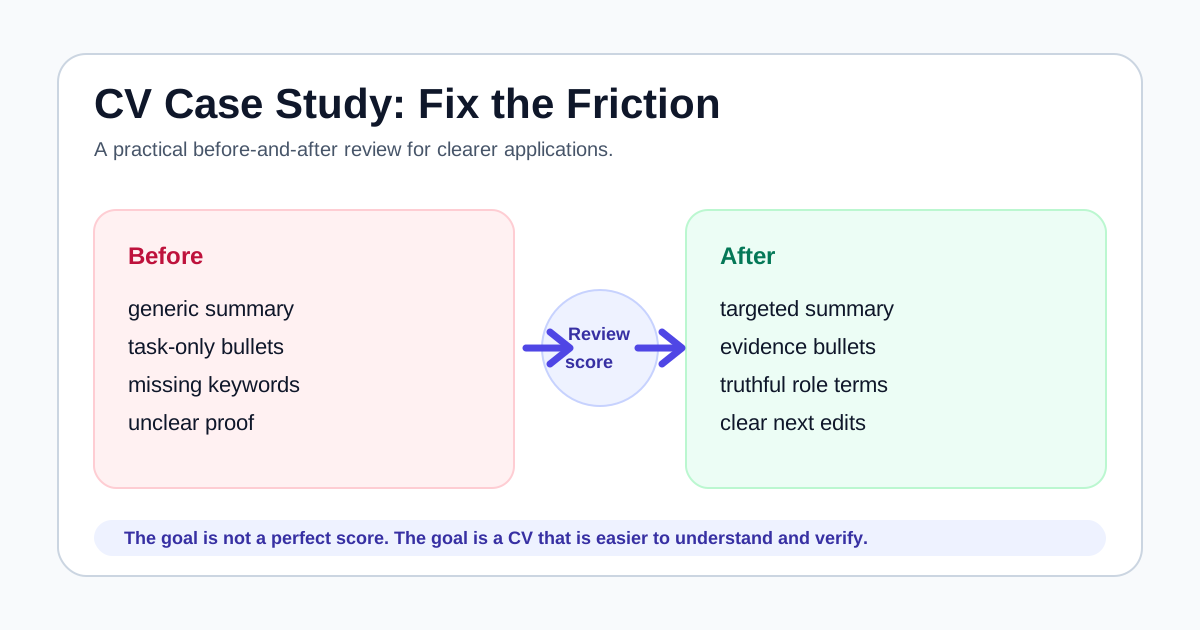
Weak CVs often fail because relevant proof is hidden, vague, or unsupported.
Before-and-after editing works best when each change solves a specific review problem.
A checker score is useful only when it helps you decide what to fix next.
The fictional starting CV
Imagine an applicant named Mira applying for an entry-level admin assistant role. Her CV has the right background: school projects, a part-time cashier role, Excel use, customer communication, and volunteer event support. The problem is that the first draft hides most of that value.
The opening summary says, 'Hardworking and flexible person seeking a challenging role.' The experience bullets say, 'Handled customers,' 'Did reports,' and 'Helped with events.' Nothing is false, but the reader has to guess what the work involved.
- The summary does not name the target role.
- Useful tools such as Excel are buried.
- Bullets describe tasks without scale or context.
- The job posting keywords are not visible.
Fix 1: rewrite the summary around the target role
A generic summary is a missed chance. Mira is not applying for every job. She is applying for admin work, so the summary should quickly show admin fit, customer communication, and basic reporting.
A better version: 'Entry-level admin assistant applicant with part-time customer service experience, Excel report preparation, event coordination support, and clear written communication.' This is still modest, but it gives the recruiter useful signals in one sentence.
- Name the role direction.
- Mention two or three relevant strengths.
- Use plain language instead of vague personality claims.
- Avoid adding skills that are not supported later in the CV.
Fix 2: turn task bullets into evidence
The old bullet 'Did reports' does not help much. A stronger version could be: 'Prepared weekly Excel sales summaries for the store supervisor using daily transaction records.' If true, that gives a tool, frequency, audience, and business context.
The old bullet 'Handled customers' could become: 'Assisted 40 to 60 walk-in customers per shift, answered product questions, and escalated refund issues to the supervisor.' Exact numbers should only be used when honest. If the applicant does not know the number, she can still add useful context such as channel, tool, or responsibility.
- Add tools: Excel, POS, Google Sheets, CRM, email, ticketing system.
- Add scope: weekly, daily, branch, team, customers, files, reports.
- Add result: faster handoff, clearer tracking, fewer missed details.
- Keep each bullet truthful and easy to defend.
Fix 3: use keywords from the actual job post
The admin job post asks for scheduling, records management, customer service, Excel, email communication, and attention to detail. Mira should not copy the job post, but she should make matching experience visible.
If she has used Excel, email, records, and customer service in real tasks, those words belong in the summary, skills section, and experience bullets. If she has never handled scheduling, she should not claim it. She can mention related event coordination only if it is accurate.
- Add only terms supported by real examples.
- Put important tools in the skills section and in relevant bullets.
- Use synonyms naturally when they match the work.
- Do not repeat a keyword just to increase density.
What the final review should check
After editing, Mira should run a final review. The important question is not whether the CV sounds impressive. The question is whether the reader can quickly understand her fit for this specific role.
ApplyReadyCV can help by checking completeness, keywords, action verbs, measurable details, readability, and application mode. The final decision still belongs to the applicant. A tool can point to issues, but it cannot verify every detail or promise a result.
- Is the target role clear in the first screen?
- Are the strongest examples near the top?
- Do keywords appear with evidence?
- Can the applicant explain every claim in an interview?
FAQ
Can I copy the before-and-after examples?+
Use them as structure, not as copy. Your CV should describe your real work, tools, scope, and outcomes. Copying examples that are not true can hurt trust.
Is this based on a real applicant?+
No. The case study uses a fictional sample so the editing method is clear without exposing anyone's private resume details.
Should every CV bullet include a number?+
No. Numbers help when they are honest and useful, but context such as tools, frequency, audience, or responsibility can also make a bullet stronger.