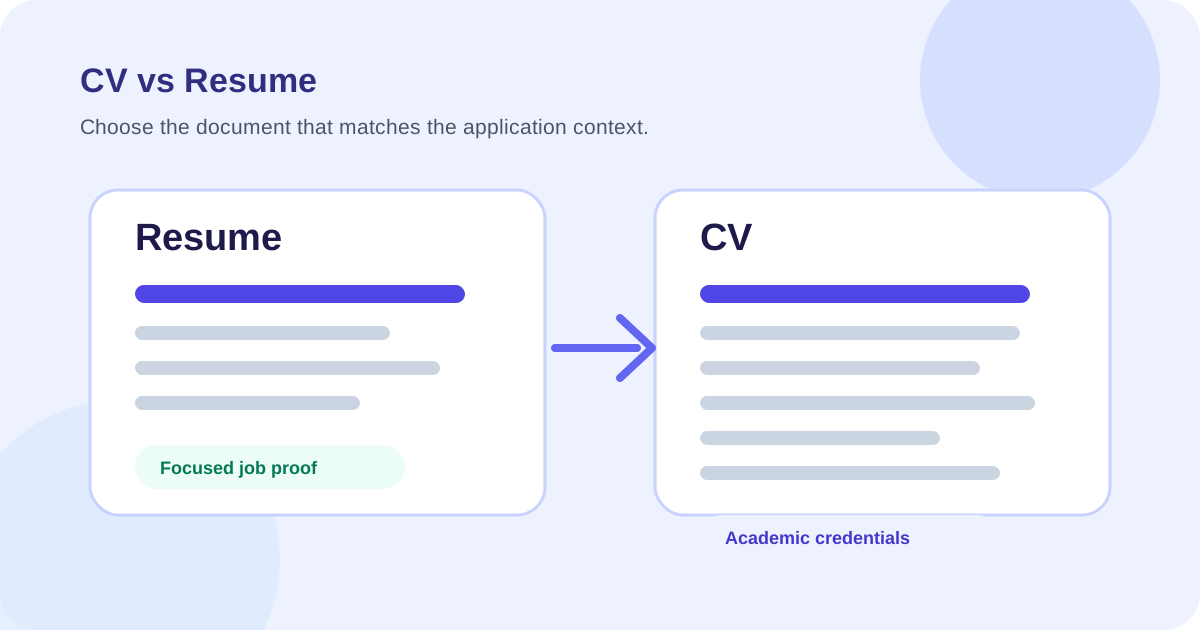
A resume is usually shorter and focused on the role you want now.
A CV is often broader and may include academic, research, publication, presentation, or credential details.
The best document is the one that matches the employer's requested format and proves the target role clearly.
The practical difference between a CV and a resume
A resume is usually a focused job application document. It highlights the education, skills, projects, and work history that best match one role or role family. A strong resume leaves out details that do not help the current application.
A CV can be broader. In academic, research, medical, scientific, and some international contexts, a CV may include publications, presentations, research work, teaching, grants, awards, licenses, and references. In some countries, CV simply means the same thing many employers call a resume.
- Resume: shorter, targeted, role-specific, often one or two pages.
- CV: broader, credential-focused, sometimes longer when the field expects detail.
- International usage: some job posts use CV to mean a standard job resume.
- Application rule: follow the employer's document request before applying generic advice.
When a resume is usually the better fit
Use a resume for most private-sector, nonprofit, government, remote, freelance, customer support, admin, operations, marketing, sales, design, and technology job applications unless the posting specifically asks for a CV.
A resume should make the target role obvious quickly. It should not be a lifetime record. Select the proof that helps the reviewer understand your fit, then remove old, repeated, or unrelated details that make the document harder to scan.
- You are applying to a normal job posting or employer portal.
- The posting asks for a resume or one-page application document.
- Your work history needs tailoring to one role direction.
- You need a cleaner version for ATS-style parsing and recruiter scanning.
When a CV is usually the better fit
Use a CV when the application asks for detailed credentials, especially in academic, research, graduate school, clinical, grant, fellowship, or teaching contexts. In those cases, cutting everything to one page can remove important evidence.
A CV still needs structure. Longer does not mean unedited. Put the most relevant sections earlier, keep headings consistent, and use enough detail for the reader to evaluate your background without hunting for the basics.
- Academic roles, research positions, fellowships, grants, or graduate programs.
- Applications that request publications, presentations, teaching, or references.
- Roles where licenses, certifications, clinical work, or research outputs matter.
- Countries or employers that use the word CV for normal job applications.
How to convert a CV into a job resume
Start with the job description. Mark the skills, tools, qualifications, responsibilities, and outcomes that truly match your background. Then move only the strongest matching evidence into the resume.
Do not delete your full CV. Keep it as a source document. Build a separate resume version for each target role family so the final document feels deliberate instead of crowded.
CV to resume editing map
| CV section | Resume decision | Reason |
|---|---|---|
| Publications and presentations | Keep only the most relevant items or summarize them. | Most job reviewers need the takeaway, not a complete academic record. |
| Research projects | Translate methods, tools, data, collaboration, and outcomes into role language. | Employers need to see how research experience maps to the job. |
| Teaching or training | Show communication, curriculum, mentoring, or facilitation proof. | These details can support leadership, support, operations, or enablement roles. |
| Long credential lists | Keep credentials that the posting requests or strongly values. | Unrelated credentials can distract from the target role. |
Check the final document before sending
After you choose CV or resume, run the document through ApplyReadyCV with the job description pasted in. The checker can help you find missing keywords, weak sections, unclear achievements, and formatting issues before you upload the file.
The checker cannot decide which document an employer wants. It can help you evaluate whether the chosen document is complete, readable, truthful, and aligned with the role.
- Confirm the employer's requested document type.
- Use consistent headings, dates, and contact details.
- Tailor the summary, skills, and first page to the target role.
- Keep a complete CV and a separate focused resume version.
FAQ
Is a CV always longer than a resume?+
Not always. In some countries, CV simply means a job application resume. In academic and research contexts, a CV is often longer because it includes publications, presentations, credentials, and research details.
Should I send both a CV and a resume?+
Send what the employer asks for. If the application allows only one upload, choose the document type requested in the posting and make it targeted to that opportunity.
Can ApplyReadyCV check both CVs and resumes?+
Yes. You can paste or upload either document. The feedback is practical guidance, not a guarantee of ATS approval or hiring results.
Sources and further reading
These references support the research and practical guidance used in this article.