Quick answer
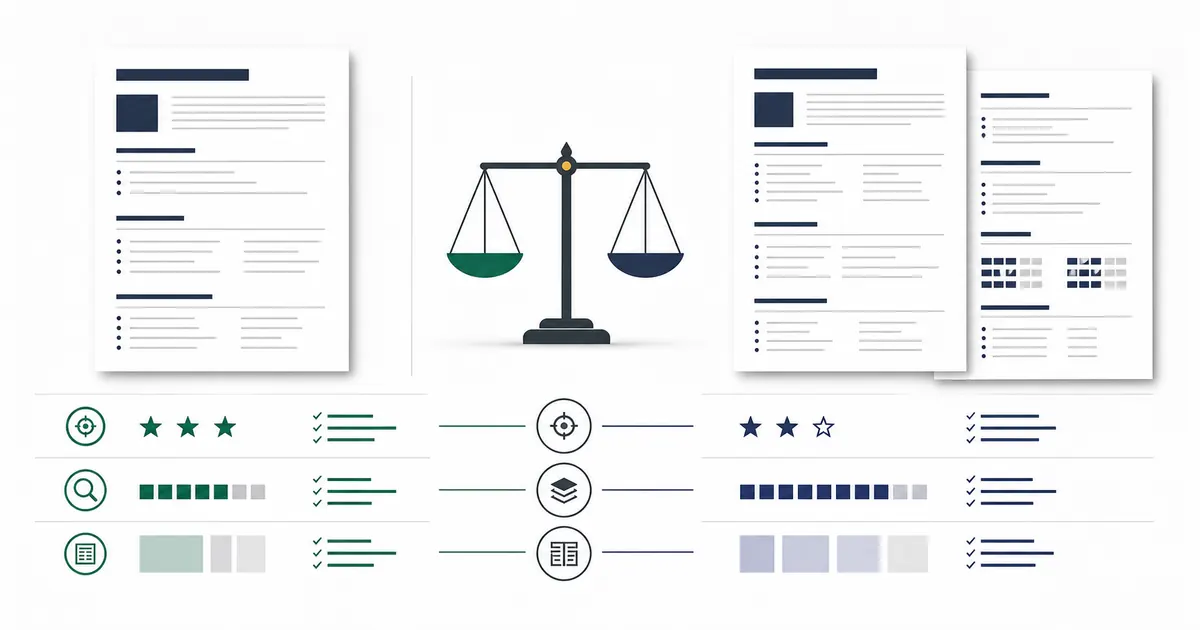
Use one page if you have under about 10 years of relevant experience, and two pages when extra roles, achievements, or technical detail genuinely support the job. Length matters less than relevance: never pad to fill a second page, and never shrink text to force everything onto one.
Choose length based on relevance and readability, not a universal rule.
One page works well for focused, early-career, or role-specific applications.
Two pages can work when the extra space adds meaningful achievements, projects, credentials, or leadership proof.
There is no universal resume length rule
The better question is not whether a resume must be one page. The better question is whether every line helps a recruiter understand your fit for the specific role.
Some early-career resumes become stronger when compressed to one page because weak filler disappears. Some experienced resumes become weaker when forced to one page because important achievements, leadership scope, technical tools, or regulated credentials get removed.
- Relevance matters more than page count.
- A crowded one-page resume can be harder to read than a clean two-page resume.
- A two-page resume is not an invitation to keep old or repetitive details.
- Employer, school, or application instructions override general advice.
Use one page when focus is the priority
A one-page resume often works well for students, fresh graduates, career changers with limited target-role proof, applicants with fewer years of experience, or anyone applying to a role that needs a direct match more than a long history.
The page should not feel like a compressed wall of text. If keeping one page forces tiny fonts, narrow margins, unclear dates, or missing achievements, the format is hurting readability.
- You have fewer than 5-7 years of directly relevant experience.
- Your strongest evidence fits without shrinking the design.
- Older roles repeat the same skills and can be summarized.
- The job posting asks for a concise resume or simple upload.
Use two pages when the second page earns its place
A two-page resume can be appropriate when the second page contains relevant achievements, technical depth, leadership scope, project outcomes, certifications, publications, regulated credentials, or client work that supports the target role.
Page two should still be useful if a recruiter skims it quickly. Do not put all important evidence on page one and leave page two as a storage area for old duties.
- You have substantial directly relevant experience.
- Your field expects project, publication, credential, or technical detail.
- Cutting to one page removes proof the job description clearly asks for.
- The layout remains readable with normal margins, headings, and spacing.
What to keep, cut, or compress
Length decisions get easier when you separate evidence from filler. Keep proof that connects to the job. Cut details that are old, repeated, unsupported, or unrelated.
If you are unsure, make a two-page draft first, then create a one-page version. Compare which version answers the job description more clearly.
Resume length editing decisions
| Content type | Keep | Cut or compress |
|---|---|---|
| Recent relevant roles | Achievements, scope, tools, metrics, and responsibilities tied to the target job. | Daily tasks that every similar role already implies. |
| Older roles | Only the details that prove transferable or target-role skills. | Long bullet lists from roles that no longer support your direction. |
| Skills | Tools, methods, languages, or certifications that match the job description. | Generic traits such as hard-working, punctual, or team player without evidence. |
| Education | Degree, certification, coursework, honors, or training that matters for the role. | Old coursework or school details that do not support the application. |
| Projects | Projects with clear tools, scope, outcome, or portfolio relevance. | Projects without context, outcome, or connection to the target role. |
Test the final length
After choosing one page or two pages, check whether the final document still works as a job application. It should have readable headings, enough white space, clear dates, strong bullets, and target-role keywords used in truthful context.
Run the resume through ApplyReadyCV with the job description pasted in. If the one-page version loses important keywords or achievements, reconsider. If the two-page version adds repetition but not relevance, compress it.
- Can a recruiter understand the target role in 10 seconds?
- Are the strongest achievements visible near the top?
- Does every section support the same application direction?
- Does the document still extract cleanly when checked for ATS readability?
FAQ
Is a two-page resume bad?+
No. A two-page resume can be fine when the second page adds relevant proof. It becomes weak when it only adds repetition, old duties, or unrelated detail.
Should a fresh graduate use one page?+
Usually yes, unless the application specifically asks for a longer CV or the graduate has unusually relevant projects, publications, clinical work, or credentials.
Can ATS software read a two-page resume?+
A two-page resume can be readable if the text is extractable and the structure is simple. The bigger risk is clutter, unclear headings, or unsupported keywords.
Sources and further reading
These references support the research and practical guidance used in this article.