Start with a focused remote-ready summary, not a generic objective.
Organize tools and skills so remote reviewers can scan them quickly.
Use bullets that prove how you work without constant in-person supervision.
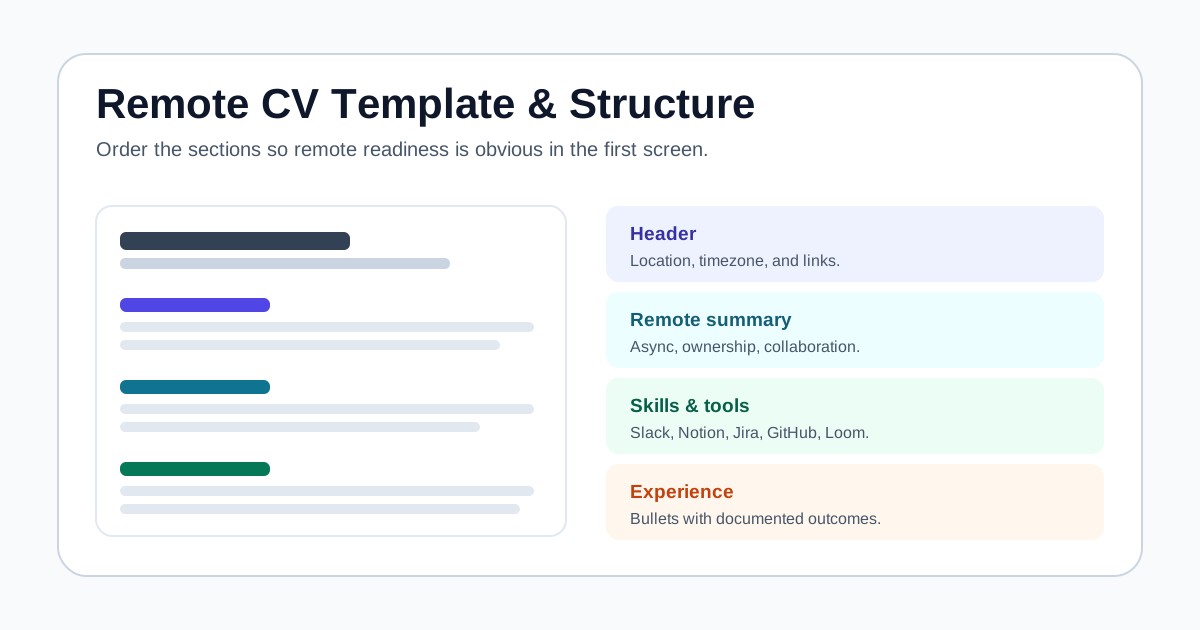
Recommended remote CV order
Use a simple structure that works for both ATS parsing and human review. The order may change by experience level, but the important point is that remote signals are easy to find.
For most applicants, start with contact details, a short summary, key skills and tools, work experience, projects, education, and certifications.
- Contact details and professional links
- Remote-ready summary
- Skills and collaboration tools
- Experience bullets with async and ownership proof
- Projects, education, certifications, and portfolio links
Remote-ready summary example
A remote summary should name the role direction and the strongest supported remote signals. Keep it short and avoid overclaiming.
Example: 'Customer support specialist with chat and email support experience, Zendesk ticket documentation, weekly reporting, and async handoff habits for distributed teams.'
Remote bullet examples
Remote bullets should show how work moved forward across tools, time zones, or written communication. A bullet can mention documentation, handoffs, status updates, project ownership, or self-managed delivery.
Use exact tools only when you used them. A tool name without context is weaker than a tool name tied to a real workflow.
- Documented support handoffs in Notion for a distributed support team.
- Coordinated Jira tickets and Slack updates for weekly release tasks.
- Prepared Loom walkthroughs and written QA notes for async review.
Choose the order by experience level
A template is a starting order, not a fixed rule. Put the strongest proof closest to the top. An experienced applicant will usually lead with recent work, while a career changer may need projects or relevant tools before older unrelated roles.
Remote readiness should appear in context instead of in a separate list of buzzwords. Show how you documented, coordinated, handed off, or completed work independently in the section where that experience happened.
Remote CV section order by applicant type
| Applicant | Lead sections | Evidence to emphasize |
|---|---|---|
| Experienced remote worker | Summary, skills, recent experience | Distributed teams, outcomes, ownership |
| Hybrid or office applicant | Summary, skills, experience | Written updates, digital tools, independent delivery |
| Career changer | Summary, transferable skills, projects | Relevant workflows and role-specific proof |
| Fresh graduate | Summary, education, projects, tools | Group projects, documentation, deadlines |
Final remote CV check
Run the remote CV checker after drafting. Look for missing remote keywords, weak ownership signals, vague tool lists, or bullets that do not show distributed collaboration.
A remote CV should still be truthful and concise. Do not add remote terms if you cannot support them in an interview.
FAQ
Should remote tools be in the skills section?+
Yes, when they are relevant, but the experience section should also show how you used those tools to coordinate work or deliver results.
Do I need previous remote jobs to apply remotely?+
Not always. You can show transferable evidence such as documentation, async updates, self-management, client communication, or distributed projects.
Should I use a special remote resume design?+
No special design is required. Clear sections, readable bullets, and proof of remote-ready habits matter more.