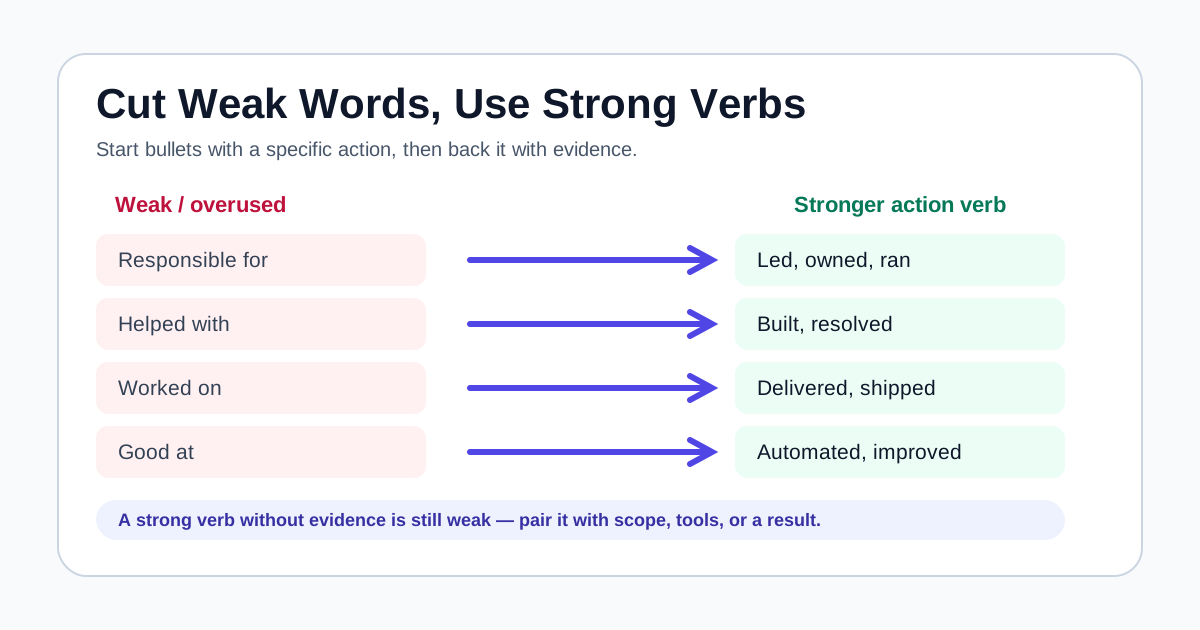
A strong action verb names your contribution; a vague or passive opener hides it.
Group verbs by function -- leadership, communication, analysis, delivery, and support -- so each bullet leads with the right signal.
A verb only lands when it is paired with honest scope or a result you can defend in an interview.
Why the opening verb carries your bullet
Recruiters skim. On a first pass they read the first two or three words of each bullet, and those words decide whether the line reads as a real accomplishment or as recycled job-description language. A bullet that starts with "Responsible for" or "Helped with" makes the reader work to find your actual contribution. A bullet that starts with "Resolved," "Built," or "Trained" states it immediately.
Action verbs also do something subtle: they signal ownership. "Was involved in a system migration" and "Coordinated a system migration across three teams" can describe the same work, but only the second makes clear what you did within it. The verb is where you claim your role, so it needs to be both strong and accurate.
The ApplyReadyCV checker scores action language as part of its readability and achievement review, and it runs entirely in your browser. It flags passive openers, repeated verbs, and bullets that never reach a result. Treat that score as an editing prompt rather than a grade -- it points at lines worth rewriting, but you decide which verb is truthful for your experience.
- The verb is the first thing a skimming recruiter reads under each role.
- Passive or vague openers hide ownership; specific verbs claim it.
- The checker highlights weak and repeated verbs, but the accurate wording is your call.
Strong action verbs grouped by function
There is no universal list of the best resume verbs, because the strongest verb is the one that matches what you actually did. It helps to shop for verbs by function: decide what a bullet is really about -- leading, communicating, analyzing, delivering, or supporting -- then choose a verb from that group. Grouping this way also keeps you from overreaching, because you are picking from verbs that fit your real role rather than the most impressive-sounding word available.
Use the table below as a starting menu, not a script. Pick the verb that describes your specific action, then move on to the evidence. Notice that some verbs, such as "resolved," appear in more than one group -- that is fine, because context decides their meaning.
- Leadership verbs claim ownership -- use them only when you actually led.
- Support and service verbs are honest and strong for BPO, VA, admin, and customer-facing roles.
- Improvement verbs work best when a before-and-after result follows them.
Action verbs by function
Choose the function first, then pick the verb that matches what you actually did.
| Function | Best used for | Strong action verbs |
|---|---|---|
| Leadership and ownership | Managing people, projects, or decisions | Led, Directed, Coordinated, Oversaw, Delegated, Mentored, Owned, Drove |
| Communication and influence | Writing, presenting, persuading, training | Presented, Wrote, Facilitated, Negotiated, Trained, Advised, Clarified, Persuaded |
| Analysis and problem-solving | Research, data, troubleshooting | Analyzed, Diagnosed, Researched, Evaluated, Investigated, Forecast, Audited, Resolved |
| Delivery and execution | Building, shipping, and hitting targets | Built, Launched, Delivered, Implemented, Automated, Produced, Completed, Shipped |
| Support and service | Helping customers, teammates, or operations | Assisted, Handled, Processed, Maintained, Scheduled, Supported, Responded, Resolved |
| Improvement and efficiency | Reducing cost, error, or time | Improved, Streamlined, Reduced, Optimized, Simplified, Standardized, Accelerated, Consolidated |
Weak buzzwords and stronger replacements
Some words show up on almost every resume and add almost nothing. Phrases like "responsible for" and "helped with" are passive; adjectives like "hard-working" and "team player" are claims a recruiter cannot verify; and inflated jargon like "synergized" or "utilized" is just a longer way to say something plain. None of these are disqualifying on their own, but together they flatten a resume into generic language that reads like everyone else's.
The fix is rarely a fancier word. It is a specific verb followed by proof. The table below pairs common weak phrasing with a stronger rewrite so you can see the pattern rather than memorize replacements. The rewrites are examples, not templates -- use your own numbers and scope.
Weak phrasing rewritten with stronger verbs
Replace passive, vague, or inflated wording with a specific verb plus evidence.
| Overused word or phrase | Why it falls flat | Stronger, specific rewrite |
|---|---|---|
| Responsible for support tickets | Passive; hides what you actually did | Resolved 40+ support tickets per shift within target response times |
| Helped the team hit goals | Vague; unclear contribution | Coordinated three teammates to clear a 200-ticket backlog in two weeks |
| Worked on monthly reports | No verb of value and no result | Built a monthly sales report that two managers used for forecasting |
| Handled various tasks | "Various" signals nothing specific | Processed payroll, onboarding, and vendor invoices for 25 staff |
| Hard worker and team player | An adjective, not evidence | Trained four new hires who reached full quota within six weeks |
| Utilized new software | "Utilized" is just a longer "used" | Automated invoice matching in QuickBooks, cutting manual entry in half |
| Assisted with projects | Weak and without scope | Supported a four-month CRM migration across three departments |
Pair every verb with evidence
A strong verb opens a bullet, but it cannot carry the whole line by itself. "Led a project" and "managed inventory" still leave the reader asking how big, how often, or with what result. The reliable pattern is verb plus scope plus result: start with the action, add how much or for whom, then show what changed or shipped. You do not need a percentage for every bullet -- frequency, team size, tools, deadlines, or volume are all defensible evidence when exact metrics are not available.
This is where verbs and accomplishments meet. Our guide on resume accomplishment examples walks through turning plain duties into truthful result bullets, and the same discipline applies here: never inflate the verb to compensate for missing proof. If you supported work rather than led it, keep "supported" and let the scope do the lifting. The table below shows how a bare verb becomes a complete, credible bullet.
- Use the pattern: action verb, then scope, then result or context.
- When you lack exact numbers, use frequency, team size, tools, or deadlines instead.
- Match the verb to your true role -- do not upgrade the verb to hide thin evidence.
From bare verb to backed bullet
Add scope and a result so the verb has something to stand on.
| Verb alone | Verb + scope + result |
|---|---|
| Managed inventory | Managed inventory for 1,200 SKUs, cutting stockouts before peak season |
| Answered calls | Answered 60-80 calls per day while keeping average handle time under target |
| Improved the process | Improved the returns process, reducing average refund time from five days to two |
| Trained staff | Trained six new agents, two of whom were promoted within the year |
Verb mistakes that quietly weaken a resume
Even good verbs can hurt a resume when they are overused or mismatched. The most common problem is repetition: a work history where every bullet begins with "Managed" or "Responsible for" reads as monotonous and makes each line blur into the next. Vary your openers enough that the reader notices distinct contributions, but do not reach for a thesaurus and land on a word that overstates your role. Reusing "resolved" twice is far better than replacing it with "spearheaded" for work you only supported.
Tense is the second common slip. Use past tense for previous roles and consistent present tense only for your current job. Mixing the two within one role looks careless. Finally, watch for inflated verbs -- "orchestrated," "pioneered," "championed" -- that promise leadership you may not be able to back up in an interview. A recruiter who asks "tell me about the time you pioneered that" will expose an exaggerated verb quickly.
- Repetition: avoid starting most bullets with the same verb, especially "Managed" or "Responsible for".
- Tense: past tense for old roles, present tense only for the current one, and never mixed within a role.
- Inflation: do not use leadership verbs for work you supported -- an interviewer will ask you to prove it.
- Redundancy: cut filler like "successfully," "various," and "utilized" that adds length without meaning.
Check your verbs before you apply
A single strong bullet can still be wrong for the resume as a whole. After rewriting your openers, read each experience section top to bottom and ask three questions: does every bullet lead with a real action, do the verbs repeat too much, and does each line reach a result or scope? The strongest verbs early in a resume also feed a better professional summary -- our guide on resume summary examples shows how to open with specific, defensible language rather than generic claims.
Run your draft through ApplyReadyCV to see where action language is thin, passive, or repetitive; the review happens locally in your browser and points you to the lines worth another pass. If you want to understand what an automated system reads and weights, the ATS resume checker guide explains how action language fits alongside keywords, formatting, and completeness. The tool narrows your attention, but the final judgment -- which verb is accurate and which result you can defend -- is always yours.
- Read each role as a block to catch repeated or missing verbs.
- Let your strongest verbs shape the summary, not just the bullets.
- Re-check after editing so the report reflects your final wording.
FAQ
What are the best action verbs for a resume?+
There is no single best list -- the strongest verb is the accurate one for what you did. Shop by function (led, presented, analyzed, built, resolved), pick the verb that matches your real role, then back it with scope or a result you can defend.
Should I start every bullet with a different verb?+
Vary them enough to avoid a monotonous list, but do not reach for a thesaurus word that overstates your role. Reusing "resolved" twice is better than swapping in "spearheaded" for work you only supported.
Are power words like "spearheaded" or "synergized" good for resumes?+
Plain, specific verbs usually read better than inflated jargon. "Spearheaded" is fine if you genuinely led the effort, but words like "synergized" and "utilized" add length without meaning and are easy to cut.
Does the ApplyReadyCV checker look at action verbs?+
Yes. It flags passive openers and repeated verbs as part of the readability and achievement review, all in your browser. Use it as an editing prompt, then make the final wording decision yourself.
Sources and further reading
These references support the research and practical guidance used in this article.