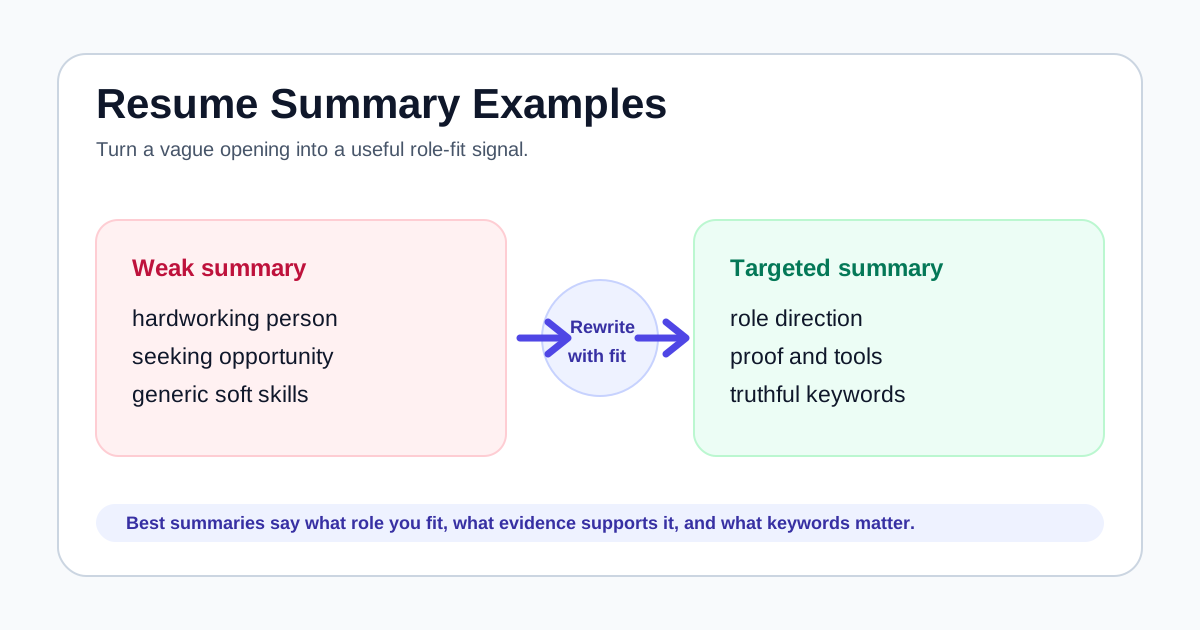
A strong summary names the target role or work direction quickly.
The best summaries connect keywords to proof, not buzzwords.
Short, specific summaries are usually stronger than broad claims.
What a resume summary should do
The first lines of a CV should reduce confusion. A reviewer should not have to guess whether you are applying for admin work, customer support, remote operations, freelance design, or entry-level IT support.
A useful summary combines role direction, relevant strengths, and evidence. It does not need to explain your whole career. Two or three focused lines are enough for most applications.
- Name the role direction or field.
- Mention tools, experience, training, or project proof.
- Use words from the job post only when they are true.
- Avoid vague claims such as hardworking, passionate, or flexible unless evidence follows.
Before and after examples
Weak: 'Hardworking person looking for a challenging position where I can grow.' Stronger: 'Entry-level admin applicant with Excel report preparation, customer service experience, and school project coordination background.'
Weak: 'Experienced freelancer who can do many tasks.' Stronger: 'Freelance virtual assistant focused on inbox cleanup, calendar coordination, research, and weekly client reporting for small teams.'
- Entry-level: connect education, projects, and tools.
- Remote: mention async communication, documentation, and collaboration tools when true.
- Freelance: lead with service, client type, deliverables, and proof.
- Local jobs: show contact readiness, role fit, and practical skills.
How to tailor a summary to a job post
Read the job description and identify the most important skills, tools, and responsibilities. Then choose two or three that you can support elsewhere in the CV.
Do not write a summary that says everything. A summary for customer support should not look the same as a summary for bookkeeping, social media, or IT support. The closer the opening is to the job, the easier the rest of the CV is to review.
- Pull role terms from the posting.
- Choose only terms backed by your experience or training.
- Keep the sentence readable for humans.
- Check that the same proof appears later in the CV.
Check the summary before applying
After writing your summary, paste your resume and the job description into ApplyReadyCV. If the checker flags missing keywords or unclear fit, review whether the summary is too broad.
The summary is not the only section that matters, but it can make the rest of the application easier to understand.
- Does the opening name the target role?
- Does it include proof instead of generic claims?
- Does it match the job without copying it?
- Would you be comfortable explaining every claim in an interview?
FAQ
How long should a resume summary be?+
For most applications, two or three focused lines are enough. The summary should help the reviewer understand your role fit quickly.
Should fresh graduates use a resume summary?+
Yes, when it adds clarity. A fresh graduate summary can mention target role, education, tools, internships, projects, or training that support the application.
Should I use the same summary for every job?+
No. Keep your core background honest, but adjust the summary so it matches the role, tools, and responsibilities in the job description.