Quick answer
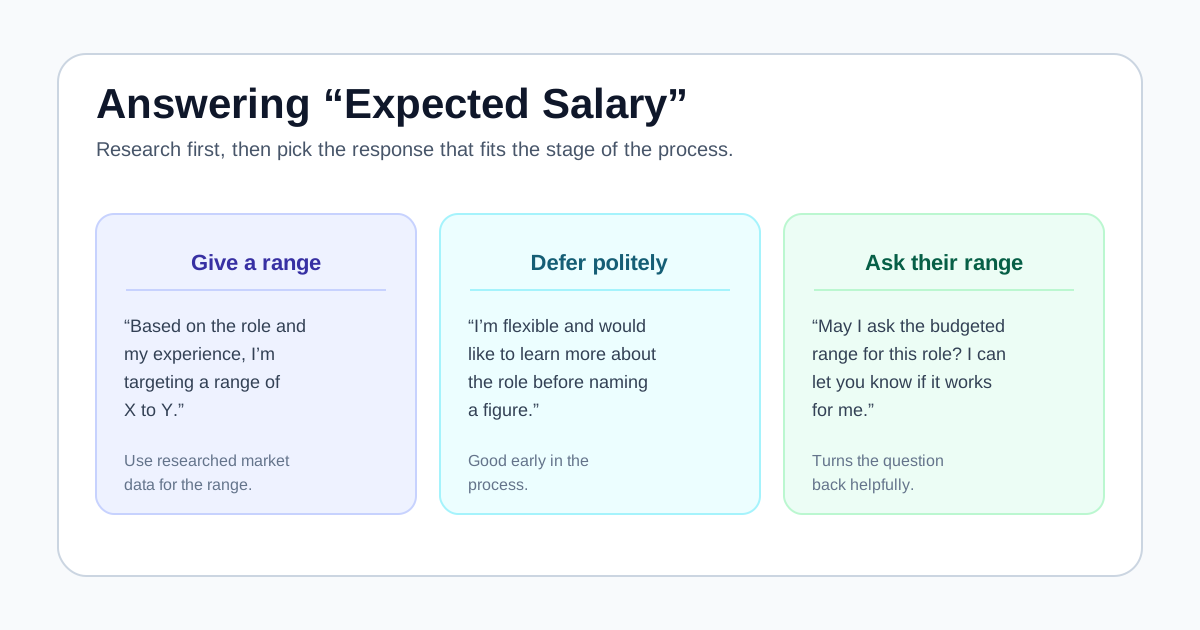
Research a realistic market range first, then either give that range, politely defer until you know more about the role, or ask for the employer's budgeted range. On a required application field, enter a researched range or your target figure rather than a single fixed, non-negotiable number.
You rarely need to commit to a final figure early; aim to stay in the running while keeping room to negotiate.
A researched range, a polite deferral, or a question about their budget are the three safe responses.
Build your range from public job postings, salary surveys, and government wage data rather than a guess.
Why the expected salary question is hard to answer
The question appears at three moments, and each gives you a different amount of room. On an online application form it is sometimes a required field you cannot skip. In a recruiter's screening email it is usually a filter to check budget fit. In an interview it opens a two-way conversation. Answer too high and you may screen yourself out before anyone reads your resume; answer too low and you may anchor the whole negotiation below your worth.
The reassuring part is that you rarely have to commit to a final figure this early. Employers ask to confirm you are roughly in range and to shortlist, not to lock you in. Your goal at the application stage is simple: stay in the running while keeping enough room to negotiate once you understand the full role, the benefits, and the total package.
This guide gives you phrasing options and a research method, not a number. What a fair figure looks like depends on your role, location, experience, shift, and the employer. Treat any range you build as your own research, and never present a market figure as a promise.
Three safe ways to respond
There are three reliable approaches, and the best one depends on how much you know about the role and whether the field is optional or required. You can quote a researched range, defer politely until you know more, or turn the question around and ask about their budget. Strong candidates mix these depending on the moment.
Giving a researched range signals that you have done your homework and remain flexible. State a band rather than a single number, and set the bottom of the band at a figure you would genuinely accept, because employers often hear the low end first. Deferring works best in an early email or interview: acknowledge the question, then say you would like to understand the scope before discussing compensation. Asking about their range suits a live conversation, where it is fair to ask what budget is allocated for the role.
The table below maps each approach to the situation where it works and the trap to avoid. Read it as a menu, not a script, and adapt the tone to the employer.
- Give a researched range when you know the market and the field needs an entry.
- Defer politely when the role details are still unclear.
- Ask about their range only in a genuine back-and-forth conversation.
- Always keep the bottom of your range at a number you would actually accept.
Which response fits which situation
Match the approach to how and where the question is asked.
| Approach | Best used when | Watch out for |
|---|---|---|
| Give a researched range | You know the role, market, and location, or a form needs an entry | Anchoring low; set the band's floor at a figure you would truly accept |
| Politely defer | An early email or interview where the scope is still unclear | Sounding evasive; pair it with a reason, such as wanting to learn the responsibilities |
| Ask about their range | A live conversation with a recruiter or hiring manager | It does not work on a one-way form and can feel pushy if overused |
How to research a realistic range
Before you can quote a range, you need evidence. Build it from several public sources rather than trusting a single figure, because any one number can be out of date, from a different market, or based on a tiny sample. The aim is a band you keep landing on from independent sources, which becomes the range you can defend calmly.
Start with current job postings for the same title and seniority in your city or region, since many now list a pay band. Cross-check reputable salary survey and aggregator pages, noting the date and sample size. For a stable baseline by occupation, government labor statistics such as the U.S. Bureau of Labor Statistics wage data give a defensible reference point, and staffing-firm salary guides add industry context. Trusted peers and professional communities fill in local, current colour that public tables miss.
Then adjust for the details that move pay: location and cost of living, remote versus onsite, company size, industry, your years of experience, and shift factors. In BPO and call-center roles, for example, night-differential pay, account-based allowances, and performance bonuses can form a meaningful part of total compensation, so research the monthly base for the specific program before you settle on a floor.
- Current job postings for the same role and level in your area.
- Reputable salary survey and aggregator pages, checked for date and sample.
- Government wage data for a defensible occupational baseline.
- Industry salary guides from established staffing firms.
- Trusted peers or professional communities for local context.
Example wordings you can adapt
The wording below is meant to be copied and adjusted, not used verbatim. Replace the brackets with your own researched figures and details, and keep the tone warm and matter-of-fact. Notice that every example keeps a door open, whether by naming a range, adding "flexible," or inviting a conversation about the full package.
For online forms, shorter is better. For emails, a single sentence that shows your research plus a note of flexibility usually lands well. In interviews, you can say the same thing more conversationally and then pause to let the recruiter respond.
Sample phrasing by context
Adapt these to your own research and the specific role. Brackets are placeholders.
| Where it is asked | Example wording |
|---|---|
| Optional form field | Open and negotiable based on the full role and total package. |
| Email from a recruiter | Based on my research for similar [role] positions in [location], I am targeting a range of [X to Y]. I am flexible depending on the scope and benefits, and happy to discuss. |
| Turning it around | I would like to make sure my expectations match the role. Could you share the budgeted range for this position? |
| Deferring early | Right now I am focused on fit. Once I understand the responsibilities, I am confident we can agree on fair compensation. |
| Required numeric field | Enter the bottom of your researched range as the figure, and use any remarks or message field to note that it is your expected base and open to discussion. |
When a form forces a single number: PH and BPO context
Many online applications, including a number of Philippine job boards and BPO application portals, include an "Expected Salary" box that will not let you submit until you type a figure, often a monthly amount. When the field accepts only one number, enter the bottom of your researched range, meaning the lowest you would genuinely accept. If the box accepts text, a short monthly band works. If it only takes digits, a round figure close to your research is fine, with "negotiable" noted elsewhere.
Two BPO-specific factors change the math. First, roles are usually quoted as a monthly rate rather than an annual salary, so research the monthly base for the specific account or program you are applying to. Second, night-shift differentials, allowances, and performance incentives can add up, so factor them in when you decide on your floor rather than quoting a bare base you would not accept once allowances are stripped out.
If the application has a remarks, cover message, or "anything else" field, use it. A single neutral line, such as noting that the figure is your expected base and that you are open to discussing the total package, gives you room to negotiate later without leaving the required box blank. Keep it short and professional.
Mistakes that quietly hurt you
The most common error is guessing without research, which leaves you unable to explain your number if asked. The second is committing to a single exact figure very early, before you know the responsibilities or benefits, which removes your room to negotiate. The third is jumping far above a posted band with no justification, which can filter you out before a human weighs your experience.
Your salary answer does not stand on its own. If applications keep stalling long before compensation ever comes up, the problem may sit earlier in the funnel; our guide on why you might not be getting interviews walks through those causes. And when you do get space to add context, a short, tailored cover letter is a better place to frame your flexibility than the salary box itself, as covered in our guide on how to write a cover letter.
Above all, keep every claim honest. Do not inflate your current pay if a form asks for it, and never present an invented market figure as fact. Quote the band your research supports, say clearly that it is a range, and let the conversation about the full package do the rest.
- Do: research a band from several sources before you answer.
- Do: keep the floor of your range at a number you would accept.
- Do not: lock yourself into one exact figure in the first email.
- Do not: quote a market number you cannot back up or explain.
FAQ
Do I have to answer the expected salary question?+
In conversation or on an optional field, you can politely defer until you understand the role. On a required form field you usually must enter something, so give the bottom of your researched range and note it is negotiable if a remarks field allows.
Should I give a single number or a range?+
A range is usually safer than one exact figure because it shows flexibility and keeps room to negotiate. Set the bottom of the range at a figure you would genuinely accept, since employers often anchor to the low end.
What if the form only accepts one number?+
Enter the lowest figure from your researched range, the amount you would truly accept. If the form has any remarks or message field, add a short line that the figure is your expected base and open to discussion, especially for allowances or shift pay.
Is it okay to say the amount is negotiable?+
On optional fields and in early emails, noting that your expectation is negotiable based on the full role and package is generally fine and honest. On required numeric fields, still enter a researched figure, then add negotiable as context rather than in place of a number.
Sources and further reading
These references support the research and practical guidance used in this article.