Treat these cover letter examples as starting points to adapt, not templates to copy word for word, because recruiters recognize generic letters quickly.
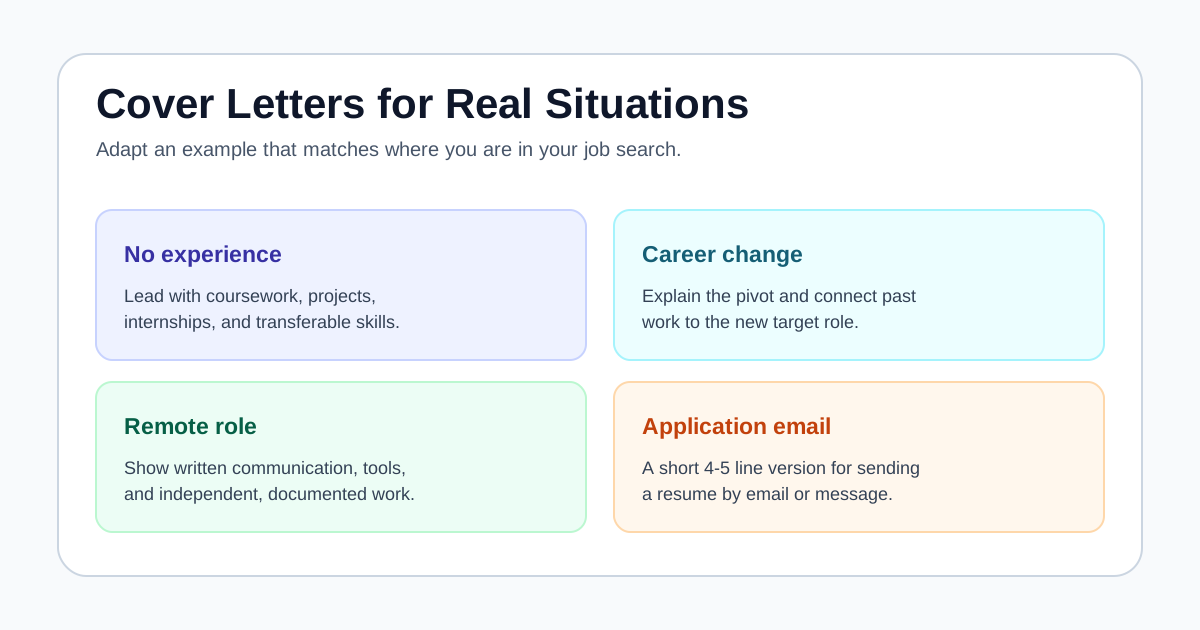
Match the example to your real situation: fresh graduate, career changer, remote role, or a short application email.
Keep every letter honest and specific, then confirm your resume and cover letter tell the same story before you send them.
How to use these cover letter examples
A cover letter example is most useful as a model, not a fill-in-the-blank form. Hiring teams read many letters, and a letter that still contains phrases like "I am a hard-working team player passionate about your industry" reads as recycled. The examples below are written so you can see how a specific, human letter is built, then rewrite each line with your own experience.
Every strong letter does roughly the same job in three or four short paragraphs: it names the role, connects your most relevant experience to what the job needs, and closes with a polite, low-pressure invitation to talk. If you want the full reasoning behind that structure, our how-to-write-a-cover-letter guide walks through each part; this page focuses on finished examples you can adapt.
As you read, notice what the examples never do. They do not promise the reader an outcome, invent metrics, or claim to be the perfect candidate. They stay accurate and specific, which is what makes them believable and what keeps you comfortable if a detail comes up in the interview.
- Opening: name the exact role and where you saw it, plus one honest reason it fits.
- Middle: one or two paragraphs connecting your real experience to the job's needs.
- Close: thank the reader and offer to discuss or share references, without pressure.
- Sign-off: a simple "Sincerely" or "Best regards" and your name.
Match the example to your situation
The fastest way to use this page is to jump to the example that matches where you are right now. A fresh graduate, a career changer, and someone applying for a remote role each need to emphasize different things, even though the letter structure is the same.
The table below shows what to lead with and what to avoid for each situation, along with a related ApplyReadyCV guide that goes deeper on the resume side. A cover letter rarely stands alone, so it helps to fix the matching resume too.
Which example fits your situation
| Your situation | Lead your letter with | Avoid | Related guide |
|---|---|---|---|
| Fresh graduate or first job | Transferable effort from studies, volunteering, or part-time work | Apologizing for having no experience | No-Experience CV Guide |
| Changing careers | The specific skills that carry over, plus proof you are learning the new field | Explaining every reason you are leaving the old field | Career Change Resume Guide |
| Remote role | Written communication, time-zone overlap, and a reliable setup | Writing as if it were an in-office job with no mention of remote habits | Remote Job CV Guide |
| Quick email application | One tight paragraph on your most relevant result | Pasting a full five-paragraph letter into the email body | Resume and Cover Letter Match |
Example 1: Fresh graduate or no-experience cover letter
This example works when you are applying for a first role and cannot point to full-time jobs yet. The goal is to show effort and reliability from whatever you have done, without apologizing. If your resume still feels thin, our no-experience CV guide covers how to fill it with coursework, projects, and volunteer work.
Dear Hiring Manager,
I am writing to apply for the Customer Support Associate role at [Company]. I recently completed my degree in Business Administration at [University], and I am looking for a first role where I can build a career in customer service.
While I am new to full-time work, I have supported real people under pressure. As a volunteer at our university help desk, I answered enrollment and scheduling questions for about 30 students a day during peak registration weeks, and I learned to stay calm, listen fully, and confirm the next step before ending a conversation.
My coursework also gave me practice with the tools your team uses. I am comfortable with email, spreadsheets, and shared documents, I type quickly and accurately, and I am ready to learn your ticketing system. I know that being reliable, teachable, and respectful with customers matters more than years on a resume.
I would welcome the chance to bring that attitude to [Company]. Thank you for reviewing my application, and I am happy to share more about how I work.
Sincerely, [Your Name]
Example 2: Career change cover letter
When you are switching fields, the reader's first question is whether your old experience is relevant. Answer it directly: name the skills that carry over and show one piece of proof that you are already learning the new field. Do not spend paragraphs justifying why you are leaving your current work. Our career-change resume guide shows how to reframe past roles the same way.
Dear [Hiring Manager Name],
I am applying for the Junior Data Analyst position at [Company]. For the past six years I have worked in retail management, and I am now moving into analytics on purpose, bringing the parts of that experience that transfer directly.
Running a store meant reading numbers every day. I tracked sales, staffing, and inventory, and I used those figures to set schedules and reorder stock. Over the last year I taught myself SQL and spreadsheet analysis in the evenings, and I rebuilt one of my old store reports as a small dashboard so I could practice on data I already understood.
I know I am early in this field, and I am not asking you to overlook that. I am offering steady work habits, comfort with people and deadlines, and proof that I keep learning without being told to. I would rather grow into an analyst role and stay than chase a title I cannot support.
Thank you for considering a candidate from a different background. I would be glad to walk you through the practice project in an interview.
Best regards, [Your Name]
Example 3: Remote role cover letter
Remote employers screen for habits an office cannot supply: clear written communication, reliable availability, and a workspace that actually functions. Name those directly. This matters for global and Philippine applicants supporting teams overseas, where time-zone overlap and a stable internet setup are real hiring factors. Our remote job CV guide expands on the same signals in resume form.
Dear Hiring Team,
I am writing to apply for the Remote Executive Assistant role at [Company]. I have three years of administrative experience, two of them fully remote, supporting a manager in a different time zone.
Working remotely taught me to communicate clearly in writing and to protect other people's time. I kept a shared inbox and calendar for a US-based executive while I was based in Manila, flagged urgent items within agreed hours, and sent short end-of-day summaries so nothing waited on a reply overnight. I am comfortable with Google Workspace, Slack, and scheduling tools, and I have a quiet home setup with backup internet.
Because remote work depends on trust, I try to be predictable. I confirm deadlines in my own words, I raise a risk early rather than late, and I do not let messages sit. I understand your team spans several time zones, and I am flexible about overlapping hours to keep handoffs smooth.
Thank you for considering my application. I would be happy to share references from remote managers I have worked with.
Sincerely, [Your Name]
Example 4: Short job-application email, plus a final check
Many applications now happen inside an email or a form field, where a full one-page letter feels too long. Send a tight version instead: a clear subject line, one or two short paragraphs, and your resume attached. Keep it scannable on a phone.
Subject: Application for Social Media Coordinator - [Your Name]. Dear [Hiring Manager Name], I am applying for the Social Media Coordinator role posted on [source], and I have attached my resume for your review.
For the past two years I have managed content calendars and community replies for a small e-commerce brand, growing an engaged following through consistent posting rather than paid reach. I am comfortable writing captions, scheduling across platforms, and reporting on what performed and why. I would welcome the chance to discuss how I can support your team. Thank you for your time. Best regards, [Your Name], [Phone] | [Email] | [LinkedIn].
Whichever version you use, the opening line does the most work, so make it specific rather than generic. The table below contrasts weak openings with stronger ones. After you finish writing, read your resume and letter together and make sure they agree on titles, dates, and your main strengths before you send.
- Keep the whole letter to one page, roughly 250 to 400 words, in three or four short paragraphs.
- Address a named person when you can find one; use "Dear Hiring Manager" only as a fallback.
- Never promise the reader a result; describe what you did and can do.
- Proofread the company name and role title twice, since a wrong one is an instant rejection.
Weak versus stronger opening lines
| Weak opening | Why it is weak | Stronger opening |
|---|---|---|
| To whom it may concern, I am writing to apply for the position advertised. | Generic and impersonal; it could be sent to any company. | I am applying for the Customer Support Associate role at [Company] because your team handles billing questions the way I like to work: patiently and in writing. |
| I am the perfect candidate for this job. | Overclaims and offers no proof. | I bring two years of remote admin experience and a habit of confirming deadlines before they slip. |
| I have always been passionate about your brand. | Vague flattery the reader cannot verify. | I have followed how your support team documents recurring issues, and I want to help keep those answers current. |
FAQ
Can I copy these cover letter examples word for word?+
No. Use them for structure and tone, then replace every detail with your own facts. Copied letters read as generic, and the specific claims will not match your resume or hold up in an interview.
How long should a cover letter be?+
Keep it to one page, roughly 250 to 400 words in three or four short paragraphs. For an email or form application, a tighter version of one or two paragraphs with your resume attached is usually enough.
Do I still need a cover letter if the job only asks for a resume?+
Not always, but a short one rarely hurts and can help when experience is thin or you are changing fields. If a letter is optional, a two-paragraph email version like Example 4 is a reasonable middle ground.
What do I write if I have no work experience?+
Lead with transferable effort from studies, volunteering, part-time work, or projects, and describe it specifically instead of apologizing. The fresh-graduate example above shows the approach, and our no-experience CV guide covers the matching resume.
Sources and further reading
These references support the research and practical guidance used in this article.