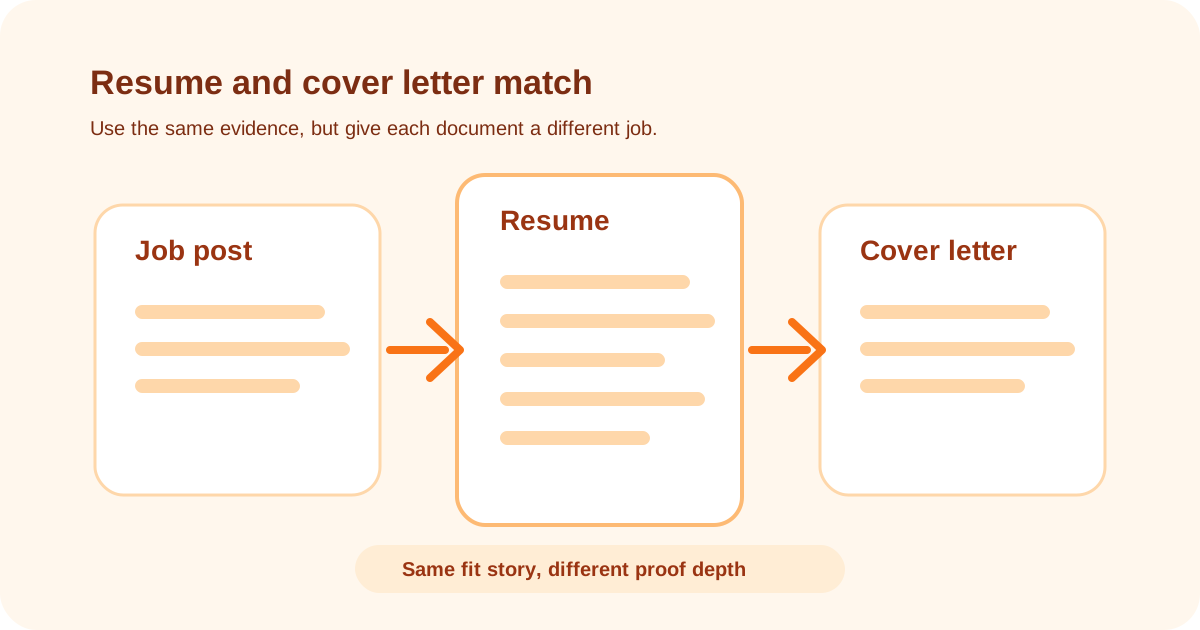
Use the same job description to tailor both documents.
Do not repeat the resume line by line in the cover letter.
Make the resume keyword-aligned and the cover letter specific to the company, role, and evidence.
Give each document a different job
The resume should make your relevant experience easy to scan. It needs clear headings, role keywords, tools, achievements, dates, education, and proof that connects to the posting.
The cover letter should not retell every resume bullet. It should introduce your fit, explain your interest in the role or organization, and connect one or two pieces of evidence to what the employer needs.
- Resume: evidence, keywords, scope, achievements, and chronology.
- Cover letter: motivation, context, selected proof, and role-specific connection.
- Both: truthful claims, clean writing, and direct alignment with the job description.
- Neither: generic filler, unsupported claims, or copied job-post language without evidence.
Start with the job description
Before editing either document, mark the role's repeated skills, tools, responsibilities, outcomes, and required qualifications. Then choose the evidence from your background that most directly answers those needs.
Use the resume to show the evidence in bullet form. Use the cover letter to explain the strongest match in a short narrative. This keeps the application consistent without making both documents identical.
- Highlight hard skills, tools, certifications, and core responsibilities.
- Identify one or two business problems the role needs to solve.
- Choose matching achievements, projects, coursework, client work, or volunteer proof.
- Remove claims from either document if you cannot support them.
Map proof across both documents
A simple mapping table prevents scattered application materials. For each important job requirement, decide where it appears in the resume and how, if at all, the cover letter expands on it.
Not every requirement needs cover letter space. Save the letter for the proof that benefits from context: a career change, a project that shows fit, a local connection, a remote work habit, or a reason you understand the organization.
Resume and cover letter alignment map
| Job requirement | Resume proof | Cover letter angle |
|---|---|---|
| Customer support and Zendesk | Skills section lists Zendesk, experience bullet shows daily ticket volume. | Explain how support documentation reduced repeat questions or escalations. |
| Remote collaboration | Bullets mention Slack, Notion, async handoffs, and timezone coordination. | Describe how you kept work moving with clear written updates. |
| Project coordination | Experience bullet shows timelines, stakeholders, and deliverables. | Connect that project to the employer's posted responsibilities. |
| Fresh graduate potential | Education, coursework, projects, tools, and volunteer proof. | Explain why the role fits your training and what evidence shows readiness. |
Avoid common mismatch mistakes
A common mistake is using a tailored resume with a generic cover letter. Another is writing a strong cover letter while the resume does not show the keywords or experience the letter claims. Both create doubt.
The reviewer should feel that the documents came from the same applicant, for the same role, on the same day. Check names, employer references, role titles, dates, and file names before submitting.
- Do not mention the wrong company or role.
- Do not claim a skill in the letter that is missing from the resume.
- Do not paste the same paragraph into every application.
- Do not use a cover letter to compensate for a resume that lacks basic evidence.
- Do not ignore employer instructions about file type, length, or required documents.
Use ApplyReadyCV as the resume check step
ApplyReadyCV reviews the resume side of the application. Paste the job description and check whether the resume includes the right role keywords, clear achievements, readable sections, and enough evidence for the application type.
After the resume is stronger, use the report to decide what the cover letter should emphasize. The best cover letter often expands on one or two important proof points that already appear in the resume.
- Run the resume with the target job description.
- Fix missing keywords only when they are truthful.
- Use the top fixes to strengthen the resume first.
- Write the cover letter around the strongest matching evidence.
- Final check: both documents support the same target role.
FAQ
Should my cover letter repeat my resume?+
No. The cover letter should expand on selected evidence and explain fit for the specific role or employer. It should not restate every bullet.
Should I tailor the resume or cover letter first?+
Tailor the resume first because it holds the core proof. Then use the strongest resume evidence to shape the cover letter.
Can I use ApplyReadyCV for cover letters?+
ApplyReadyCV is primarily a resume and CV checker. You can use the resume report to decide which evidence the cover letter should emphasize.
Sources and further reading
These references support the research and practical guidance used in this article.